Sunday, December 1, 2013

Multi-Cultural Nativity Sets, and the Wise Men Who Couldn't Get There

          During a recent trip to Jerusalem, I went to Bethlehem. It's only about 10 miles away from Jerusalem, though it's within the borders of the West Bank.  One of the oldest churches in the world is there, sitting on top of several caves, which is where Jesus is said to have been born.  It's a cool place to see, though I don't really like the church itself because it is so dark, and I don't like the crowds either.  In addition to the church, we visited the Bethlehem Peace Center, which is right next door.  They have various exhibits, and there was one showing a really neat collection of nativity sets from all over the world. I picked some of my favorites to show here.
          I especially liked the ones that were a little bit different.  For Christians, and probably a lot of people in the West who aren't Christians, the picture is a familiar one: Mary (usually in blue, showing purity, though she could never have afforded it) and Joseph, shepherds and some sheep, and the wise men (usually three of them, one to represent each of gold, myrrh, and frankincense).  Perhaps a donkey, an angel, and a camel if you're lucky.  And all have the newborn, who is really the important part, lying in the feeding trough (we usually say manger, but that's what it was).  Anything that's different stands out.  They reflect a number of different cultures, which is awesome because God created us all to be different and to be creative.
This one is from Switzerland, and I like how crowded it is.  I'm sure the real stable was more like this, with no personal space.  And I like the fluffy sheep.

This one is from Sweden and, as Adri put it, looks very Swedish and just like it stepped out of an Ikea catalogue. 

This one is from Australia, and made to look like a frontier town.  The creativity is really striking.  It's the Royal David City Hotel, and Mary has the baby on her hip and looks rather sassy.  And I love the lady sticking her head out of the window.


This is from an Inuit group in either Canada or the US. Apart from the angel that had fallen over, the style of dress is interesting because it's based on the Inuit style, not the Middle Eastern type of dress.  And there's a moose instead of a camel, and a sleeping polar behind the dog-sled manger.  
A life-sized Chinese nativity set!  You can tell that Mary and Joseph were poorer than the rich guy, which can sometime be easy to miss.  And they had the sense to keep the cow away from the baby.

A Hungarian Puppet Nativity!  (and my Hungarian Roommate)
The decorations are traditional ones, and the puppets are just fun.

This one is made inside of a walnut shell.  It must have taken a lot of skill to make.  


I don't remember exactly where this one was from, but it somewhere in Africa.  The shiny spot is just my flash, but Jesus is in a hanging basket, not on the floor.  There's also a pig, even though Bethlehem would have, at least in theory, been kosher, so no pigs.

This one is just pretty, but there is just one wise man and one shepherd.

          The last one isn't exactly my favorite, but it is very startling.  This nativity set is from Bethlehem, and made of olive wood (which, apart from growing olives and making nativity sets, isn't actually that useful).  The modern city of Bethlehem is located in the West Bank, which is sort of a separate country from Israel, but it's under Israeli military control (it's really complicated).  It's an Arab town, and has both Christians and Muslims who live there (there are lots of Arab Christians all over the Middle East).  To get in from Jerusalem or anywhere else in Israel, you have to go through the wall.  It's concrete, but on the Arab side it's been decorated with paintings. Some of them are beautiful, others are sad, and some are very political.  A section near Bethlehem has stories of different people displayed on the wall.  Many are about the giant wall and its effects, with sad stories and heartwarming stories, though some are just about daily life.  Regardless of your political opinion on the subject, it's sad and ugly and I wish it wasn't there, and that there was never a reason (however good or bad) to build it.
This is the wall.  It's huge (not even a really tall person could touch the bottom of the posters) and rather ugly.  
          The picture below shows what the Nativity might have looked like if Jesus was born today.  Mary and Joseph and the shepherds would have been in a stable together, still stuck in their poverty (the West Bank is really poor).  And the wise men would have been stopped by the huge wall.  Even if they were allowed in through the special gate in the wall for tour buses, they would have had trouble finding the baby lying in a barn, because it would have been down a back street.  
The wise men who couldn't get there.
          Bethlehem has always been a special place in my imagination.  A little village, with a dusting of snow, a shining star, and a new baby crying in the hay.  The real Bethlehem was probably crowded and loud and stinky and hot.  The real Bethlehem is still crowded and loud, and sometimes smells a bit strange, and now feels like a huge mess with a wall that seems permanent.  But the point of Bethlehem wasn't that there was a pretty picture.  The point was the little baby, who came to bring peace and hope.  The little baby grew up, and taught me to reach across walls, both physical barriers like walls and mountains and oceans, but also the ones we build up inside ourselves.  And then he died, but rose again, to tear down the wall between us and God.  Until all of the walls in the world fall down, the little baby who would have been stuck behind one gives people on both sides of the wall hope.  Hope for a resolution, hope for reconciliation, hope for peace.

Thursday, November 28, 2013

A McDonald’s Thanksgiving, with Strawberries and a Side of Homesickness


            Happy Thanksgiving from Nazareth!  It’s not a holiday here, nor is it cold.  The traffic is it’s normal crazy self, but nothing out of the ordinary.  This morning at chapel, we did sing a number of thankful songs.  I don’t think they’re traditional thanksgiving anything, but we sung them in Arabic and English.  And somehow being thankful made me think of home, and then homesickness hit me in the middle of chapel.  Unfortunately, my emotions tend to come out of my eyeballs, but in some ways that’s probably best, because I can’t hide it.  Pretending you’re great when you’re not so okay isn’t helpful.  Crying in public is embarrassing, but there were lots of people I know who care about me who gave me hugs and told me that’s it’s okay to be sad and that I’ll feel better soon.  Most of them have lived abroad, or have children who live abroad, so they’ve been there.  I sat with our volunteer coordinator for a while, and drank a cup of tea, because that’s what British people do. 
Then I went for a walk, because my mom says that exercise is good for your emotional, as well as physical, health.  I walked to the big grocery store across town.  It may not have been quite so great for my physical health because I bought stuff to make a chocolate pie, which is what we always have at thanksgiving.  I also got crasians, because they were the only cranberries I could find (I love cranberry sauce), and strawberries, because November is strawberry season in Israel.  (Admit it, you wish strawberries were a Thanksgiving food)
I caught the bus home by power-walking to the next stop while it was in traffic so that I didn’t have to walk up the hill.  I baked my pie, which helped me feel better because I like being busy.  My mom emailed me the recipe, but it was still a little weird to make it without her in the next room to yell for when I needed help. I had to make several substitutions, and I baked it in a cake tin because the pie pan is a tin disposable one that looks highly questionable.  And I licked the pot, which is a time-honored thanksgiving tradition at my house.
And for Thanksgiving dinner, I had McDonald’s with Adri because it was the most American thing we could think of.  Yes, I know McDonalds is not the healthiest, and it will never compare to thanksgiving dinner at home.  But it still tasted like home in it's own way (it's funny what I like here for that reason, even though I'd never, for example, drink peach iced tea at home). It was fun and silly, and silliness is always a good way to keep homesickness away.  There were scary purple trees to laugh at, and Christmas decorations to look at in the mall, which almost felt sinful since thanksgiving wasn't over yet.  We came home and ate pie, which didn’t really solidify in the refrigerator like it was supposed to, so we ended up eating it out of the pan.  With strawberries.  It wasn’t as good as my moms (because nothing ever is), but it still tasted yummy. 
Even though I’m halfway around the world, I have so much to be thankful for, including the opportunity to be here (even if I get homesick sometimes).  I have two lists of ‘things I’m thankful for”.  One list is things that I’m thankful for here in Nazareth, because it really is wonderful.  The other is things I’m thankful for at home, because I realize how much I have at home when I don’t have all of it here, or at least not in the same way.  Each has three things, not because I only have six things to be thankful for, but because I have SO much to be thankful for that I doubt anyone wants to read all of it.

In Nazareth
1- I’ve gotten to know so many people, and they all care about me.  In addition to the other volunteers, I’ve made friends with people at the hospital, Nazareth Village, and church.  I’m halfway around the world, but I’m in no way alone.
2-  The time I’ve been given to learn Arabic, and the brain God gave me to learn and use it. Arabic is really hard, and it still can be pretty hard now.  But I can usually make myself understood, and I can talk to people who don’t speak English, which is especially nice in the hospital.
3- God made a really amazing and beautiful world.  Nazareth looks nothing like North Carolina, but it’s still beautiful with the palm tress and the flowers that bloom in November.  The hills are more aptly described as steep mountains, but they don’t fall down and have their own rugged sort of beauty.  The Jezreal Valley is barely visible from my doorstep, and is flat and green.  I’ve been to the Dead Sea, the Sea of Galilee, and the Mediterranean, which are all different shades of blue, and different again from the Atlantic Ocean and the lake at camp (we won’t discuss the Crim Dell at William and Mary, though God created the flesh-eating bacteria that live there too).

At Home
1- I’m thankful for my family and friends.  There are a lot of both, and they’re all wonderful.  Maybe a little bit crazy, but they (or rather, YOU) are my crazy family and friends.  It makes home seem not so far away when I get random facebook messages that say things like “I saw this” or “this came on”, followed by “it reminded me of you”.  Both my family and my friends are strewn about the world, but they are all still there and still care about me, and I care about them. And I thank God for them as often as I remember, and it’s never often enough.
2-   I’m thankful for the internet and the technology that makes living in a different country a little easier.  From talking to people with Skype, to seeing pictures, to being able to find instructions in English, it just makes it easier.  It’s silly, but it’s still very true.
3- I’m thankful for my home country.  I’m never as patriotic as when I’m away from home (except maybe during the Olympics).  Yes, the US has it’s own set of problems and it's in no way perfect. But when I see everyone else’s problems, especially up close and personal, I’d chose our problems.  I like our diversity, because even though it can make things more difficult, things are also richer and more interesting.  I like our political system.  It’s slow and messy and I like to complain as much as the next person, but it’s still one of the best out there.  I like our food, even if we should eat better and less overall.  I like our culture, though probably mostly because I understand it.  I like our infrastructure, because it’s nice to flush toilet paper and use the oven and microwave at the same time.

So I hope you have a wonderful day, full of loved ones, blood relatives or not, and food, and time to remember all of your blessings.  Happy Thanksgiving!


Friday, November 22, 2013

Not All Who Wander


“Not all who wander are lost”  - JR Tolkien
This is one of my favorite quotes, and is fairly appropriate to my preferred method of travel.  Now, I’m not one to just wander around with all of my stuff on my back, no sure destination, and no place to spend the night.  I'm not that adventurous; I like knowing where I’m going to sleep and knowing that I can find food, and how I’m getting home again.  But there is something wonderful about wandering around and seeing what you find.
            Today I had a lovely wander through Jerusalem.  I’ve been visiting Jerusalem with my friend and fellow volunteer Adri, but this morning we split up so we could each see different things (neither of which actually got seen).  I wanted to go to the Rockefeller Museum, but it’s closed on Fridays (I don’t know why, because it's open on saturday, which is Shabbat and the day when everything else is closed).  I decided to walk towards the old city and see what I could find.  I stopped in several stores along the way, and then headed towards a church that I saw down a side street.  It was a Russian Orthodox church that was built fairly recently (probably in the past 100 or 150 years).  The inside was beautiful, but I didn’t stay long.  I followed signs towards another museum, apparently about underground prisoners, which was also closed on Fridays.  (Hopefully I’ll go back, because it looked interesting)
I walked through a municipal complex back towards the main street, passing the trial court and some other government buildings.  I ended up in a courtyard with a modern art installation.  I generally don’t like modern art, but this one was unique, interactive, and playful.  It was a group of brightly painted bicycles, raised off of the ground, with their gears connected to various things on poles above the bikes.  

There were phonographs that played music when you peddled, and lights that came on, drums that beat, and fans that spun.  

I was there by myself at first, and I’m sure I made a strange picture.  I happened to have on a long sleeved shirt and a long skirt, which coupled with my long curly brown ponytail makes me fit in well with the orthodox and ultraorthodox Jewish neighborhood.  So most people passing by probably saw an orthodox girl happily riding a bicycle to play an Edith Piaf tune out of a phonograph. After a few minutes, a man came and rode one of the bicycles with a drum, and we smiled and waved at each other.  (to all of my matchmaking friends, no, stop, not THAT kind of man) It felt like I was in a Pixar movie.
My path then snaked through the old city.  I went in through the Jaffa Gate, but didn’t follow the crowd of tourists through the market.  I strolled through the Armenian Quarter, and found a place to get hot chocolate.  There isn’t a whole lot to see in the Armenian Quarter, because most of their churches and houses are huddled behind walls and heavy gates. 
Then I walked through the Jewish Quarter, though I startled a man in the market on my way there.  He sneezed and said something in Arabic as he passed me, so I said “Bless you” in Arabic.  He looked really confused, but gave the reply (everything you say in Arabic has a proper reply) and said thanks.  And I got a what-on-earth glance from the kippa-wearing man in front of me who witnessed this exchange. 
The Jewish Quarter has some really neat ruins that have been preserved for viewing underneath the more modern buildings. Most of them are on the Cardo, a reconstructed street from Roman times.  There are also actual ruins nearby, including a section of wall that contains parts from the first temple period (ie a really long time ago, and a really long time ago here is about 800 BC).  
I think the part in the bottom right corner is the oldest part.
As I headed back towards the Jaffa gate to meet up with Adri, I found a museum that was actually open.  It’s a museum of what life was like in the Jewish Quarter during the 19th century.  There are lots of objects from daily life.  Some look very Arab (and were probably used by Sephardic Jews from the Middle East, not Ashkenazi Jews from Europe), others look more European and even modern, and a couple looked like they were artifacts discovered in an ancient city (there was a grain mill like the one in Nazareth Village and the ones found at Masada).  There were wedding dresses and cooking pots, and even a collapsible canopy bed, which was apparently rented out to new mothers for their 40-day recovery period after giving birth.
Adri and I ate our peanut butter and jelly sandwiches in the shadow of the city wall, then went to find the place of the last supper.  On the way there, we stopped at a garden along the city wall that had plaques explaining the history of the wall that surrounds the old city.  The current wall was actually built in the last 500 or so years, but it contains older parts of the wall as well.  Then we stopped to take silly pictures in those boards with pictures and places cut out for faces.  

We found the ‘church’, but it mostly seems to be on top of a Yeshiva, so it was hard to find what we were looking for.  I don’t know if we found the supposed room or not, but we did get a nice view of the outskirts of Jerusalem from the top.  There was also a closed Holocaust memorial.  On our way back, we wandered through a beautiful neighborhood that felt completely empty, but had lots of pretty flowers, and saw a park and another outside art exhibit, and some dancing soldiers outside the city wall.

In terms of seeing-all-the-sites, wandering around may not be the best way to travel.  You may miss things because you didn’t know when they were open, and you may waste some time being lost-ish, especially if you don’t have a good sense of direction and it’s a big place.  It might annoy your traveling companions and make you tired from walking around in circles.  But for me, there’s nothing quite like wandering around and seeing what you find.  The funny little roads and gates, the hidden museums and shops, and seeing where normal people actually live.  Here in Israel, it’s especially important, because what life looks like from the tourist sights is nothing like daily life.  And you don’t need to be half way around the world, or even in a city.  Just go out side, go for a wander, and see what you find.   
  

Saturday, November 9, 2013

Baking in Nazareth (or the story of how Google is wonderful)


            I really, really, really like to bake, much to the benefit of those who lived in dorms with me, and much to the annoyance of my mother, who says that it’s bad for her diet.  So of course, after I’d been in Nazareth for a couple of weeks, I wanted to bake something.  At first I thought that baking from scratch would be too much of a hassle, due to the whole I-can’t-read-anything part of life in Nazareth (there’s a blog post about illiteracy under this one).  Trying to figure out which box contained baking soda versus baking powder seemed like a stretch when I was lucky to get the right kind of juice.  I thought that a good solution would be to buy one of the box mixes, where you add eggs and oil and water, mix it up, stick it in the oven, and eat it.  They aren’t the same as homemade, but they’re pretty good.  You can buy the same Pillsbury mixes here in the grocery store, except that all of the instructions are in Hebrew.  They don’t even have pictures like most of the mixes at home do.  So… I’ll be good at baking from scratch by the time I get home, even if I do learn to read Hebrew eventually.

The lady in the hospital kitchen gave me flour and sugar and apples, and the nice man at the store at the bottom of the hill helped me find baking soda.  I found a recipe that used ingredients that I had (thanks Google), and I baked a lovely apple cake.  Except that it wasn’t really so lovely after all.  I’m going to the blame the oven and not the chef.


This is our oven.  Instead of things on the dial that make sense like ‘bake’, ‘broil’, and whatever else your oven might say, there are a lot of pictures, with boxes and circles and squiggles.  These mean absolutely nothing to me.  So I just picked one that made the oven hot, converted Fahrenheit into Celsius, and went for it. It didn’t work so well.  The cake got burnt on the top, and wasn’t cooked in the middle.  We ate it anyways (it tasted okay if you put it in the microwave), but I didn’t want to waste my time trying to bake things that wouldn’t cook.  Yes, the emergency room is only a skip and a hop away, but I’d rather not get food poisoning. 
            Again, Google to the rescue.  The brand name of our oven is in English, so I was able to find an instruction manual online.  I don’t think it was for this model, but it showed pictures of the boxes and circles and squiggles and explained what each was for.  Hence the sticky notes adorning the back of our oven in the picture.  I don’t want the next person who lives here to have to eat a simultaneously burnt and raw cake.
       

            Once we had the oven more or less under control, I tried to bake chocolate chip cookies with two of the other volunteers.  And they came out really well!  We used a different recipe than the one I use at home because we didn’t have brown sugar or the molasses to make a substitution (thanks Google, for helping find the recipe).  We also didn’t have a proper cookie sheet, so we put the balls of dough in a brownie pan instead. I checked with Google, to see if anything terrible would happen.  Just so you know, it works fine.  And if you’re ever desperate to bake cookies and don’t have a cookie sheet or anything else that’s designed to go into the oven, you can apparently wrap the oven rack in tin foil.  It’s not recommended.  I don’t quite know what to make of that information, but that’s what you get with Google.
            So baking has been an adventure, but we haven’t set the house on fire or set off the smoke alarm (mostly because we don’t have one).  We do flip the breaker for the kitchen, and sometimes our entire apartment, and I’m still not quite sure why.  But I know how to fix it, so perhaps I’ll figure out how to not flip the breaker in the first place.
             
Lessons from Baking
-  You should know where your breaker switches are.
-   People will usually help you find strange ingredients at the grocery store.
-  Recipes are often more guidelines than actual rules.  You can use baking soda instead of baking powder, and it’ll probably work.  Same for using 500 grams of butter instead of ½ cup.
-  Google can convert units so that you don’t have to.
-   Google can also help you learn from other people’s mistakes.
-  There’s nothing like eating chocolate chip cookies and watching a movie.

Since then I’ve baked brownies and a fully cooked apple cake, which I may have finished for breakfast this morning.  And now there’s butter thawing on the counter to bake another batch of cookies.

Monday, October 28, 2013

I'm Illiterate Here (and it's really annoying)


            I’m not illiterate in the real sense of the word; I can read English, Arabic, and some Romance languages.  But I cannot read Hebrew, so I’m functionally illiterate in Israel.  Occasionally, I can match two written words together by looking at the shapes, but that requires having two copies of the same word and that both are in the same font.  Even in the Arab towns, everyone knows Hebrew, so that’s the language that’s used.  For names of stores, for labels, for caution signs.  It isn’t that I expect everything in the world to be labeled in English, but it is a very different experience and way to go about living.  Here are some weird ways that it has affected me thus far (with pictures where I could get them without being strange).


  • Grocery Shopping- This is the task that's changed the most. One must go looking for the type of container that something is normally in, looking at the color of what’s inside and the picture on the front, and hope that it’s what you want.  Or ask the guy at the counter, who is usually very helpful and often speaks English.  I'm really thankful that I don't have any severe allergies, because I would have no way to ensure that I wasn't eating something dangerous.
So it looks like corn flakes. With honey

Yes! not only something I recognize, but something that tastes like home.
But apparently the stuff with the blue lid is crunchy.
I'll now have to write my shopping list based on lid colors.

Well, perhaps that'll be good, whatever it is (it wasn't)

Care to guess the brand?
The picture helps, but good luck figuring out the different flavors from a whole display.
Especially if you're picky
    Aha!  It's a brand I know, with a picture I know, and at least some of it is written in English.
    Brand name recognition is really useful

  • Baking - I love to bake, but I was having trouble finding baking soda or baking powder (though I eventually found it).  One day in a grocery store I saw a pillsbury brownie mix, and thought that might be a good way to bake without trying to find ingredients (because I have to have the guy at the counter help me, because I can't read).  I looked at the back to see what you had to add, and promptly realized that this wasn't going to work so well either, due to the fact that the directions were all in Hebrew.  Without any pictures.  On the plus side, I'll learn to make everything from scratch.
  • Caution Signs- what does the picture below say?  Is it a political sign or advertisement that got stuck there?  It is a caution sign saying “keep of the rocks”?  Your guess is a good as mine.  Luckily no one yelled at us.

  • Directions- If I want to get the bus to go to Nazareth Illit or Kafr Kana (the biblical town of Canaa, by the way), I have to make sure I know the number and which side of the road to stand on.  The bus shelters have signs with the numbers on them to show which buses stop where, and presumably the name of where they're going written under it.  If I get confused, I just have to ask someone and hope that they're nice and helpful.

  • Mail- I like to send snail mail, but so far I've been to the Post Office six times, and only succeeded in mailing something once.  Not only do I not know when the post office hours are, I can't read the days of the week on the sign with the hours, so I can only write down the times in a some sort of order, and try to guess at which day is which.  Today they were closed because of a holiday, but fortunately they had a sign in Arabic as well as Hebrew so I could read it and not walk all the way there tomorrow when they will still be closed.

  • Signs- I tried to get into the pharmacy at the bottom of the hill this week and the doors had a great big red sign on them.  Perhaps a “do not enter” sign?  Or the name of the store that just happened to look really scary?  Luckily the security guard on the inside waved me through the door.  I’m still not sure if that’s the right place to go in or not.

  • Bathrooms- thank goodness for the fairly-standard symbol for ‘restroom’, with the little stick figures, one of which has on a skirt.  However, signs are sometimes just words, which can be rather useless if you can’t read.  One time I and some friends successfully followed the symbols to a door with a little stick figure in a skirt on it.  But then there was a sign on the door, presumably saying that the bathroom was closed for some reason.  (Luckily there was a readable number on the door, so we were able to guess where we needed to go to find another bathroom)
I've always thought that reading was important and the most important part of school, but I never realized how much of my daily life revolves around reading.  I just finished college and want to go into academia, so I do spend time reading scholarly things, like books and journal articles.  I also enjoy reading for fun (since I now have the time), and I even have to read to know what's going on in the world (the news) and in my world of my friends and family (facebook).  An illiterate person is not only excluded from those things, they have to have an entirely different way of coping with daily life.  

Wednesday, October 23, 2013

Praying in a Different Language

            One of my favorite tasks here at the hospital is helping with the chaplains, who are local volunteers who go around the hospital to talk with patients and pray for them.  It is sometimes really hard, because people are often sad, lonely, or hurting in a hospital, and it’s all a bit outside of my comfort zone.  I’m not a medical person, and just being inside of a hospital is a little weird and uncomfortable.  Then trying to meet people that I don’t know and understanding them and their pain in Arabic adds another layer of complexity.  I am always with another local volunteer who can help me with the Arabic when I get confused, which helps a lot. 
My first week here, I would offer to pray for patients with the addendum “mumkin ana aslaha likii bil inglesia?”  “May I pray for you in English?”  A wonderful little old lady in the dialysis ward told me that in Arabic or English, God understands.  Still, I wanted to pray for them in a language that they knew, because I would find it a little weird for someone to be praying for me when I couldn’t understand them.  I talked to one of the local volunteers about wanting to learn to pray in Arabic, and I tried praying for her in Arabic.  She said it was fine, and that from then on I should pray in Arabic.  No more learning needed.  So that was that. 
It can be hard to pray in a foreign language.  I mostly sound like a five year old.  I’m sure that a lot of the verbs don’t get conjugated correctly.  I probably use the wrong words sometimes, or just make up words altogether.  Sometimes the other volunteers have to help me with words in the middle.  Some things are just too complicated for me to communicate well in Arabic.
And yet, God understands me.  My prayers are slow and halting and might cause an Arabic grammarian to fall over faint, but I’m talking to my God, and he understands.   As a Christian, this is so important for me to realize and think about.  God always understands our prayers.  Whether they’re beautiful works of poetry that rhyme, whether it’s a simple song from a child, whether it’s a nonsensical mutter in a foreign language, whether it’s a groan and a plea that no human words could ever describe, God understands.  The patients seem to understand me too, and seem to be aware that I’m not a native Arabic speaker.  And no one has yet commented on the American woman who goes around praying in Arabic.
 I’m learning that many of the things I pray for aren’t really all that complicated.  Thank you God for this person.  Thank you for their life.  Please heal them.  Please give them peace.  Please help them, because you love them.  In the name of Jesus the Messiah, Amen.  The most complicated thing that I’ve prayed for was for someone’s daughters to find husbands, and that was only hard because I needed to use the rare feminine plural verb conjugation.  I tend to think that prayers need to be complicated and specific, and there is a time and a place for that.  But sometimes, simple works just as well.
A note on why I chose to pray the way I do, as opposed to just learning the Lord’s Prayer or another pre-written one.  I did this on purpose.  The Lord’s Prayer and similar ones have a great purpose: to help us as the church pray as a unified body, and to help us individually pray when we can’t find words to say.  These are very important, and if you don’t know any, I would recommend that you learn one.  But prayer is our opportunity to talk to God.  To say, “Hi Dad”.  I call my earthly father just to talk about what’s going on in life, and I can do the same thing with God.  Think about that.  The God who created heaven and earth is willing to sit and talk with you.  About great big important things, like wars and famines, but also about little things, like missing home and being tired and cranky. I want my prayers to not only talk to God about this person, but to give them an idea of how to talk to God.  That you can talk to God about anything.  Yep, God doesn’t mind hearing about hopes that your daughters will find husbands and that he will make dialysis less painful in the same prayer.  And that there is so much to thank God for, even when you’re in the hospital.
Hopefully, my prayers will improve in their grammatical structures (though I will never bother with trying to speak proper classical Arabic), and my topics of prayer will expand a bit with my growing vocabulary.  If you speak a second language, I encourage you to try praying in a different language.  Not as a grammar exercise, but as a faith exercise in really thinking about your prayers.  Maybe it’ll be beautiful and make your French teacher proud.  Or maybe it’ll wind up as “Hi God, thanks, bye.”  Either way, God understands you and is happy to hear from you.
 

Monday, October 14, 2013

What Nazareth Looks Like

I've commented that it is a little weird to live in Nazareth, especially because most tourists see the basilica and Mary's Well and maybe the market, then leave after two hours.  I've been here for three and a half weeks, and I've only just gotten here.  I recently posted some 'tourist' pictures on my facebook, with the amendment that I rarely see these things, except as landmarks to use if I get lost.  This blog post is mostly pictures that show a little bit more of the place of where I live.

A Map
A map of Nazareth
This is map shows Nazareth Hospital (aka the English Hospital), which is where I live and work.  The Nazareth Village, right below our hospital, is a living history museum (like Colonial Williamsburg) that shows what first-century Nazareth would have looked like.  My apartment is on the hospital grounds, where I live with three other volunteers.  The hospital grounds are fairly big, and I live at the top.  On the map, it's between the Freres de Betharram Monastery (which I'm pretty sure is actually a convent, but maybe both are there and they just didn't label the convent) and the Carmelite Convent.

Nazareth
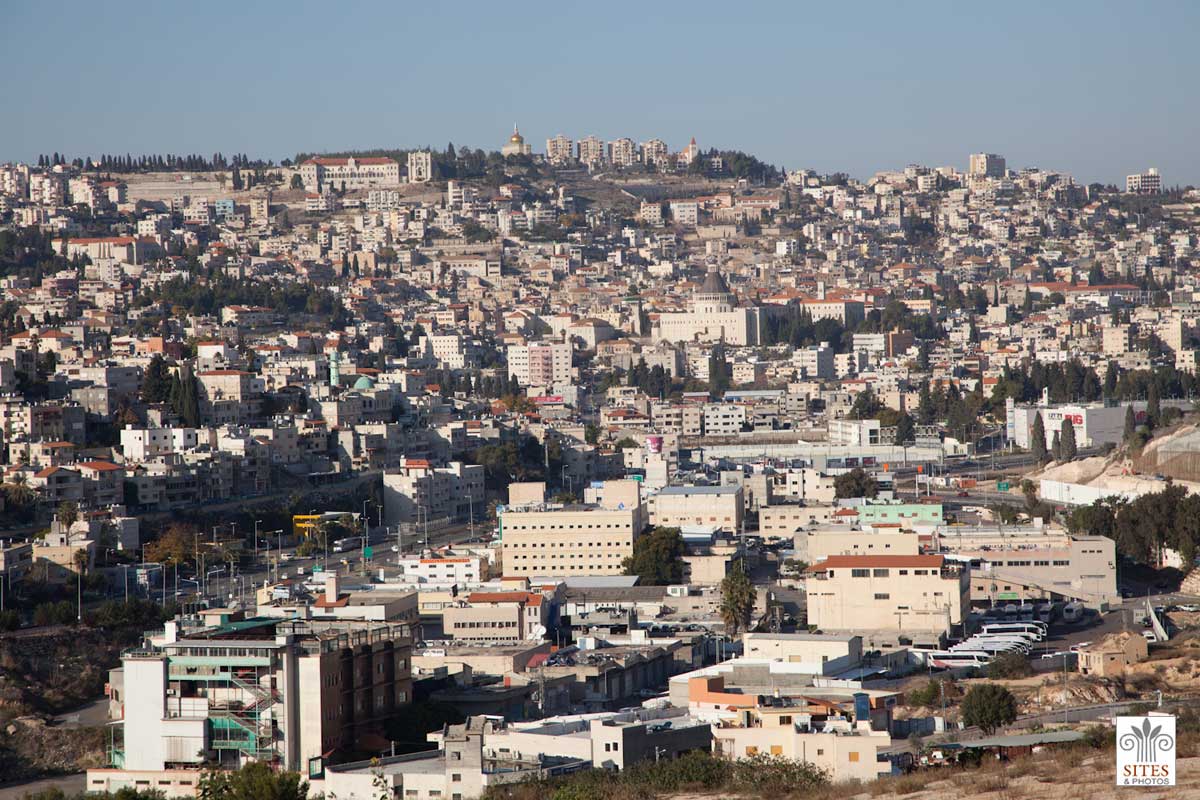
 If you look at the picture of Nazareth below, there's a big basilica in the middle (the Basilica of the Annunciation).  One the horizon, there's a shiny dome (a mosque), and to the left is a big church-looking building next to a long building.  That's the Salesian school, and how I can best find the hospital from far away.  The hospital is a little down and to the left, but it's not visible in this picture (sorry, google-ers can't be choosers).
Nazareth
Nazareth is basically in a bowl.  The Basilica and the main road are in the lowest and flattest part, and that's where first-century Nazareth was and where Jesus would have grown up.  It's a steep climb up from there to the hospital.  Once you get to the hospital, there are 189 steps from the hospital entrance to our apartment.

See what I met by steep?
(no, I didn't tilt the camera funny)
Above the bowl and on the other side of the mountain is Nazareth Illit, a predominately Jewish town.  It's listed as "Upper Nazareth" in the map.

The Hospital
A picture of the hospital, taken from Nazareth Village
This is the hospital, generally called the English Hospital (al-mustashfa al-inglesi in Arabic), officially Nazareth General Hospital EMMS (Edinburgh Medical Mission Society, who founded it).  There are wards, an emergency room, several outpatient offices, and a nursing school, as well as several Christian organizations that have offices here (including the International Fellowship of Evangelical Students (IFES), which is the umbrella group of Intervarsity, the campus fellowship group I was a part of in college).
The hospital sign at the bottom of the hill
The view from the hospital is great, though the climb that makes it so spectacular doesn't feel so great while you're climbing up.
The view of Nazareth.
The cliff right above the lightpost is where they say that the people of Nazareth
were going to push Jesus' off when they didn't like him.
Mount Tabor is in that general direction, and if you go a short ways up the hill you can see it.

A view of Nazareth in the other direction
This is the view directly outside of my front door.  You can see the convent next door, and we hear their bells along with the bells of many other churches in the city.  And we even have trees!
Trees! and a convent
This last picture is of our balcony.  It's a nice place to sit, and also where we hang out laundry.  There are cats and a chicken that roam around the hospital, and this one is my favorite, even though he's always trying to get inside (and sometimes succeeding).
So this Nazareth.  Modern day, real, living, chaotic, steep, Nazareth.  Yep, Jesus did live here two thousand years ago.  And his presence is still present in the city.  And yet for me it is really easy to forget that Jesus did grow up here, because I see Nazareth as a place where people I know live.  And for the next six months, I live here too!